
Modern Yoga is Younger Than You Think (and why it matters)
Last week, we explored the idea that yoga postures aren’t meant to look identical on every body. This week, we’re diving deeper into why that’s true through a brief look at the history of modern yoga. Because when you understand how the practice evolved, the pressure to “do it right” begins to soften in a very real way.
Many people come to yoga carrying a quiet concern: Am I doing this correctly? They wonder why certain poses feel accessible for others but not for them, why their bodies feel stiff or strong or limited in different ways, or why their progress doesn’t look the way they expected. Over time, that uncertainty can turn into comparison, and comparison can slowly chip away at the very benefits that drew them to yoga in the first place.
Here’s the part that often brings relief: the physical yoga most of us practice today is relatively new. Yoga itself is ancient. Understanding the difference between those two things can change how you relate to your practice entirely.
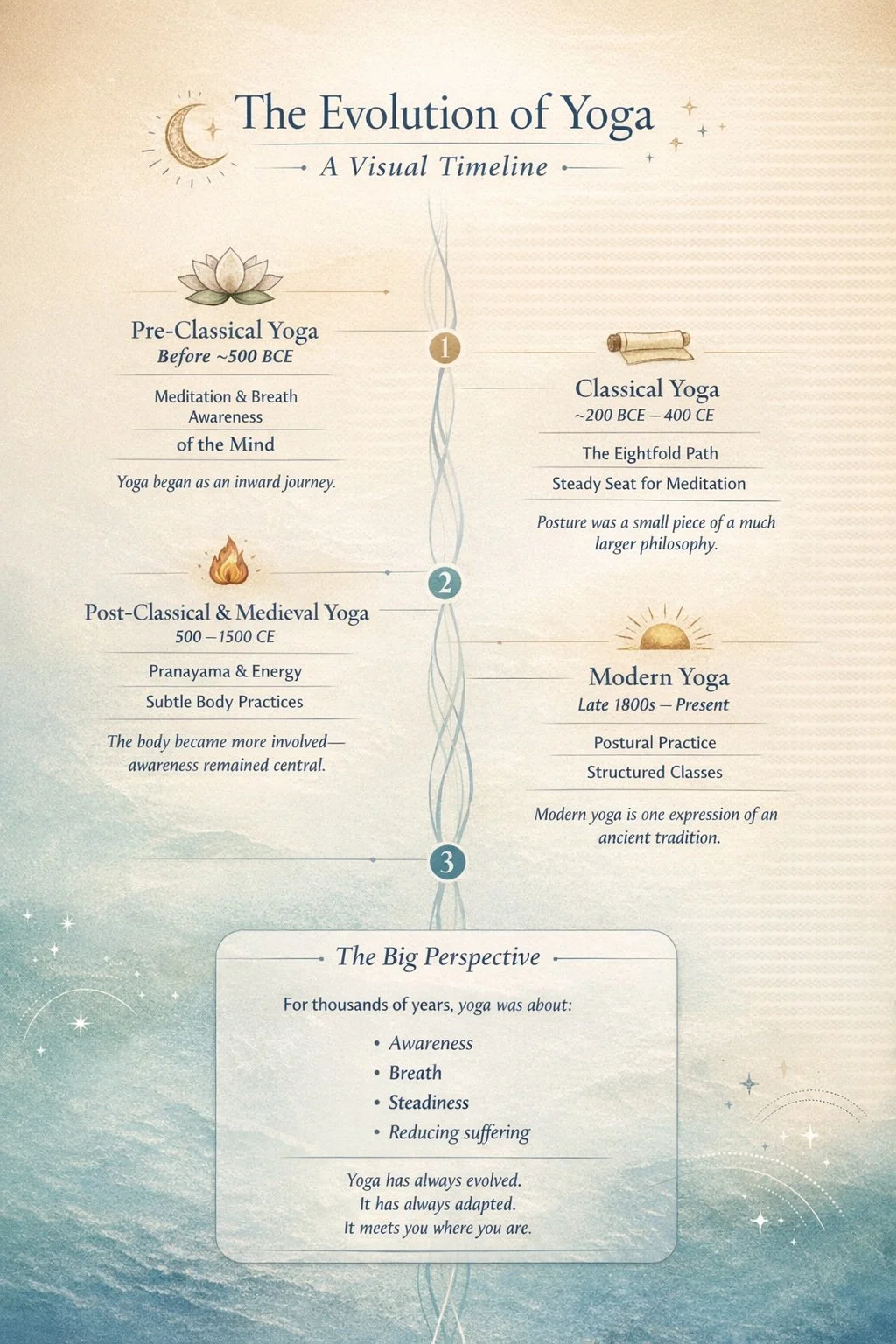
A Brief Timeline of Yoga
Yoga has never been static. It has evolved over thousands of years, adapting to culture, geography, and human need.
Pre-Classical Yoga (before ~500 BCE)
The earliest roots of yoga are found in ancient India. Practices were primarily contemplative and spiritual, focused on meditation, breath awareness, and understanding the nature of the mind. The emphasis was not on physical postures but on inner stillness and self-inquiry.
Classical Yoga (~200 BCE – 400 CE)
This period is often associated with the Yoga Sutras, a foundational philosophical text outlining yoga as an eightfold path. Posture (asana) was only one small component, and it was described simply as a steady, comfortable seat for meditation. The larger goal was clarity of mind and freedom from suffering.
Post-Classical & Medieval Yoga (500–1500 CE)
During this period, practices expanded to include more physical techniques, breath control (pranayama), and energetic concepts. Some seated and a few more dynamic postures appeared, but yoga was still not a system of flowing sequences or fitness-based classes.
Modern Yoga (late 1800s – present)
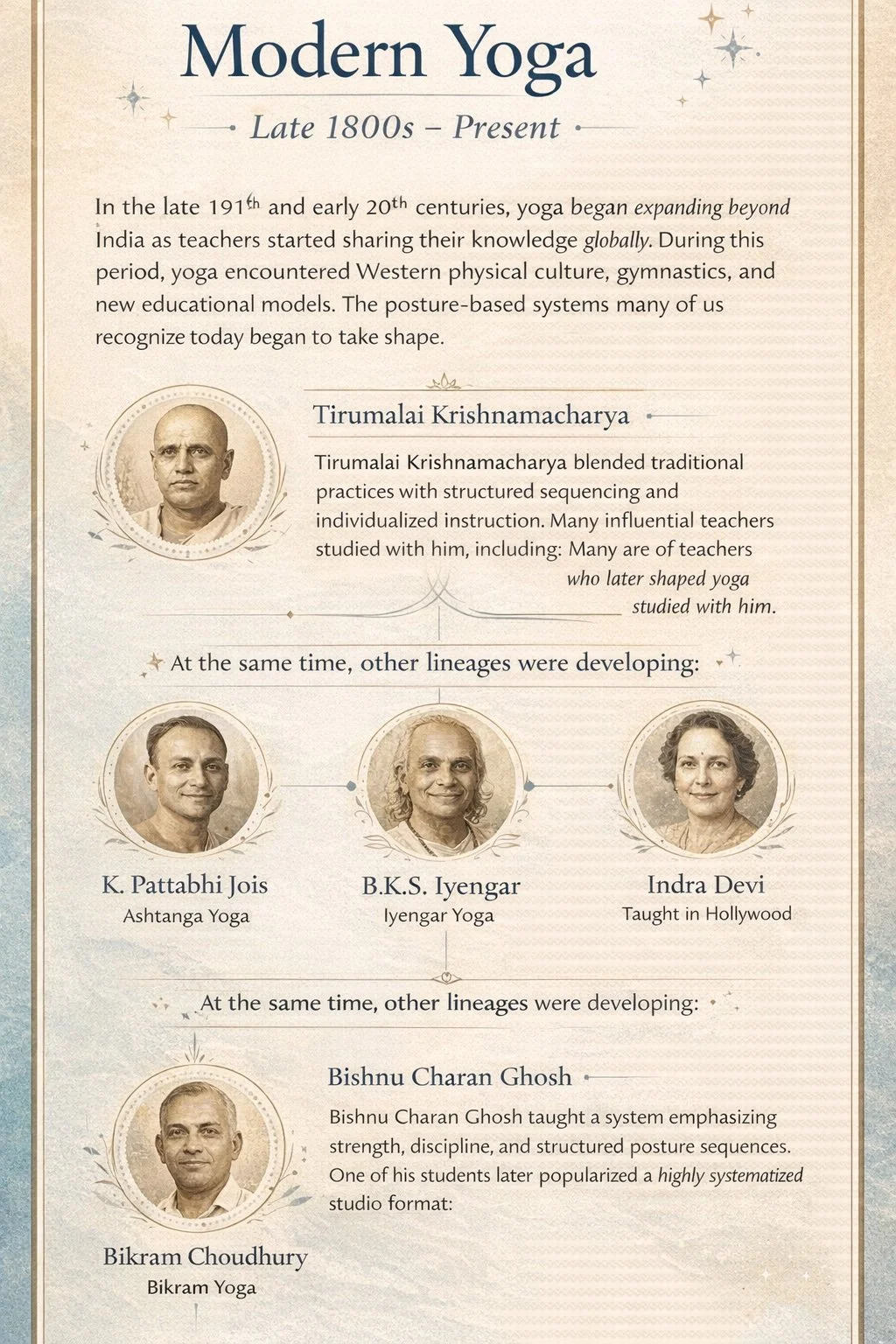
In the late 19th and early 20th centuries, yoga teachers began sharing practices beyond India. As yoga encountered Western physical culture and gymnastics, the posture-based systems many of us recognize began to take shape. Sun Salutations, standing pose sequences, and structured class formats developed during this time.
When you step back and look at this arc, something becomes clear: the yoga of studio schedules, heated flows, and carefully cued alignment is a very recent chapter in a very long story.
And that perspective matters.
Yoga Was Never Only About the Body
For most of its history, yoga was centered on awareness—on noticing the mind, regulating the breath, and cultivating steadiness. Flexibility was not a requirement. External shape was not the goal. The physical body was important, but not as a performance.
When we forget this broader history, it’s easy to believe that deeper stretches or more advanced shapes equal progress. But when we remember that posture was originally described simply as a stable seat for meditation, the pressure begins to loosen. Yoga was never meant to be a comparison sport.
The deeper questions have always been quieter. Can you stay present when sensation arises? Can you soften when your instinct is to push? Can you respond with awareness instead of force?
Rethinking What It Means to “Do It Right”
If modern postural yoga is young and yoga itself is ancient, then there is no single correct way a pose must appear. Bodies differ in structure, mobility, injury history, and season of life. Expecting uniformity in outward form ignores the diversity that has always existed.
Struggle in a pose is not evidence that you are failing. Often, it is the very place the practice begins. The shaking leg, the wandering mind, the urge to come out early—these are not interruptions of yoga. They are invitations into it.
When we measure success by awareness rather than appearance, something shifts. The practice becomes less about achievement and more about relationship. Less about proving and more about listening.
Releasing Comparison and Perfectionism
When yoga is understood as an evolving, centuries-old practice of awareness, there is more room.
Room for props.
Room for rest.
Room for aging bodies and beginners.
Room for strength and for softness.
Understanding the history of yoga doesn’t make modern classes less meaningful. It makes them more compassionate. It reminds us that what we are doing on the mat is part of an evolving tradition, not a test we must pass.
A Gentle Reminder
Yoga does not ask you to become more flexible, more accomplished, or more impressive. It asks you to notice, to breathe, and to respond with care.
When you understand that the poses are just one doorway into a much older and wider tradition, the pressure softens and comparison loosens its grip.
If you are breathing, paying attention, and showing up—even imperfectly—you are not behind. You are practicing.
Yoga isn’t something you succeed at. It’s something you return to. And if you can breathe here, you belong.