
Stillness Feels Hard for a Reason—and Learning It Can Change How You Sleep

One of the biggest myths about yoga is that you have to quiet your mind to do it “right.”
This belief often keeps people away—especially those who spend their days holding everything together and their nights replaying conversations, making mental lists, or staring at the ceiling unable to sleep.
When that same busy mind shows up in savasana, it’s easy to assume something has gone wrong.
But a racing mind doesn’t mean you’re failing at yoga.
It’s a doorway to the kind of rest you’ve been missing.
Before we dive into how yoga can help you learn quiet your mind and achieve better rest, let’s first understand why that’s important in the first place. Then we’ll acknowledge why, exactly, it is so hard and uncomfortable to sit with our thoughts. And finally, we’ll offer some tools and techniques to help you practice.
Why Sleep—and Nervous System Regulation—Matter More Than We Realize
Sleep isn’t just about feeling rested. It’s one of the primary ways the body repairs itself—physically, mentally, and emotionally.
Research consistently shows that quality sleep supports:
Emotional regulation and mood stability
Memory, focus, and decision-making
Hormonal balance and metabolic health
Immune function and inflammation control
When sleep is disrupted—especially over long periods—the body stays in a low-grade state of stress. Cortisol remains elevated. The nervous system stays alert. And even if you’re technically “sleeping,” you may not be getting the deep, restorative rest your system needs to operate at its best.
This is where the nervous system comes in.
The parasympathetic nervous system—the same system we practice activating in yoga, Yin, breathwork, and savasana—is responsible for initiating the body’s natural sleep cycle. It’s what allows heart rate to slow, muscles to soften, digestion to resume, and the mind to downshift.
If this system isn’t easily accessible, sleep often becomes difficult:
Falling asleep takes longer
Waking during the night becomes more frequent
Returning to sleep feels hard or impossible
In other words, sleep issues are often regulation issues, not discipline issues.
Why Learning to Be With Your Thoughts Changes Sleep
The disregulation that is keeping you awake at night is the same racing mind making savasana or Yin yoga uncomfortable.
Let’s normalize this part, because it matters.
In savasana, Yin classes, or any other extended moment of stillness, it is completely common to experience:
Racing or looping thoughts
Restlessness or the urge to move
Unexpected emotion—tenderness, tears, irritation
The desire to skip it altogether
None of this means you’re bad at yoga.
It means you’re human.
It isn’t a sign of failure or weakness. It’s a sign that your system finally has enough safety to slow down and an invitation to activate your parasympathetic nervous system—the opposite of the always-on, fight-or-flight mode so many of us live in. What arises doesn’t need to be pushed away. It’s simply passing through as your body relearns how to settle.
Learning to stay with your thoughts gently, without escaping them, can change how you rest, how you sleep, and how you unwind at the end of the day. It offers a way to truly settle—rather than simply numb or distract.
Yoga Offers a Training Ground For Your Nervous System
By learning to stay present with thoughts in a safe, supported way—on the mat, in stillness, in breath—you teach your nervous system that it doesn’t need to stay alert to keep you safe. Over time, this creates a ripple effect:
The mind becomes less reactive to thoughts at night
Waking up doesn’t trigger the same spiral of worry
Rest feels more accessible, even if sleep isn’t perfect
This isn’t about forcing calm. It’s about building capacity.
And that capacity—practiced slowly and consistently—supports not just better sleep, but a more resilient, grounded nervous system overall.
When the nervous system can regularly access rest, people often notice:
More patience and emotional steadiness
Less reliance on end-of-day numbing habits
Improved energy during the day
A greater sense of ease in their body
This is why the practice matters.
Yoga isn’t just about flexibility or strength. It’s about teaching the body how to shift gears—so rest becomes something you can access naturally, not something you have to chase or force.
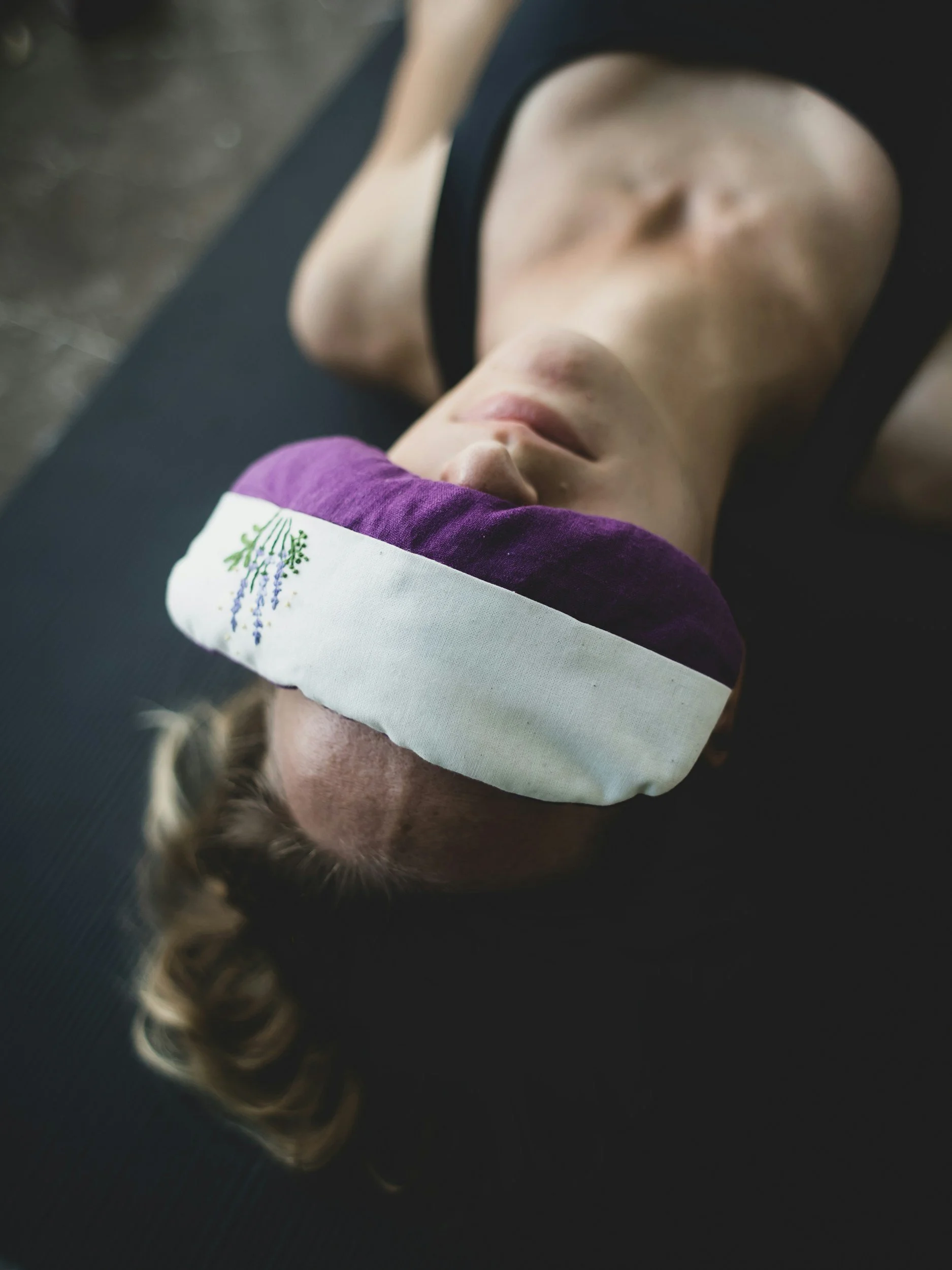
When Stillness Feels Uncomfortable: Gentle Anchors to Try
“But Julia, it’s still feels impossible.”
I hear you! For many people, including myself, stillness needs an anchor—something simple to rest attention on while the nervous system settles.
Below are a few of my favorite tried-and-true ways to anchor the mind. You don’t need to “do them perfectly.” You’re simply giving your mind somewhere to softly land.
1. Count the Breath (Simple + Steady)
This is one of the easiest ways to quiet mental noise without forcing silence.
Try this:
Inhale through the nose for a slow count of four
Exhale through the nose for a slow count of six
Silently count each inhale and exhale at your own pace: one… two… three… then start again
If you lose count, that’s okay. Just return to one.
This longer exhale gently signals safety to the nervous system and helps shift the body out of “doing” mode.
2. Box Breathing (For Very Busy Minds)
If your thoughts feel loud or scattered, structure can help.
Try box breathing:
Inhale for four
Hold for four
Exhale for four
Hold for four
Picture tracing the four sides of a square with each phase of the breath.
This technique gives the mind a clear rhythm and visual to follow, which can be especially helpful for people who feel anxious, overstimulated, or on edge.
3. Repeat a Simple Phrase (Mantra or Sankalpa)
Sometimes the mind just wants words.
Choose a short, simple phrase and repeat it silently with your breath:
I am safe.
I can rest here.
Inhaling, I arrive. Exhaling, I soften.
If your thoughts wander, gently return to the phrase—again and again, without frustration.
This isn’t about positive thinking. It’s about offering the nervous system a steady, reassuring signal.
4. Scan the Body, One Area at a Time
If lying still makes you feel disconnected or uncomfortable, a body scan can help you stay present without zoning out.
Try this:
Bring attention to your feet
Notice temperature, weight, or sensation
Slowly move awareness up through the legs, pelvis, belly, chest, shoulders, arms, neck, and face
At each body part, you can softly or silently say to yourself: “Let go.”
This practice helps the mind stay anchored in the body and often reduces the urge to fidget or move.
5. Give Yourself Permission to Move (Yes, Really)
Stillness doesn’t mean freezing.
If your body needs to shift:
Adjust your legs
Take a deeper breath
Place a hand on your belly or heart
Small movements can actually help the nervous system settle. Comfort supports relaxation—forcing stillness often does the opposite.
Beyond the Mat: Supported Stillness
It’s also worth saying this: lying still on a mat isn’t the only doorway into regulation.
Some people find stillness easier when it’s supported by sensation or structure.
For example:
Sauna offers warmth, containment, and stillness without requiring you to lie down
Cold plunge anchors attention through breath and sensation, giving the mind something clear to focus on
Structured recovery practices can feel more accessible for people who struggle with traditional meditation
There is no one right way to find calm. There are many valid entry points—and all of them count.